Scott's Health Tips:
Tick Bites
Health Tip #29, 23 April 1997
 Welcome to this, the second-to-last Health Tip! Only one more of these and then I retire. Cindy and I will still be here for you through finals in case you have any medical or health needs or questions. We still have lots of band-aids and condoms in case you want to stock up for after the end of the semester.
Summer being almost here now, that will often mean hiking, backpacking, and camping, and thus that can also mean ticks. The two main kinds are the dog tick (the larger one) and the deer tick (the teeny one). They�ll find some nice place on your body to dig in, suck blood, and consequently spread Rocky Mountain spotter fever, Colorado tick fever, tularemia, or Lyme disease. You might not notice the ticks right away since they often don�t cause very much itching. Some other symptoms that come up are rash, headache, fever, swollen glands, stiff neck, and general fatigue.
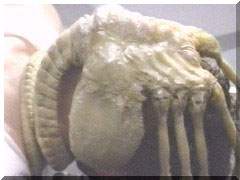
Some ways to avoid these acarids (they�re not insects, but are related to arachnids such as spiders, and perhaps are even more distantly related to H.R. Giger�s fictional facehuggers and chestbursters shown above!) include (1) using a repellent containing DEET (diethyltoluamide), (2) wearing long sleeves, long pants, and high socks, (3) tucking the pants into the socks (Sure it looks dorky, but what would you prefer: bad style or bad ticks? Besides, if you are wearing rubber boots for water-terrain, that would cover both the pants and socks), and (4) checking your exposed skin often and brushing off any wanderers who haven�t anchored yet.
If you do get a tick on you, you should remove it as soon as possible. There are lot of old wives� tales about how best to do this, including one that says you should use vaseline to make the tick think it has gone in too far and would then back out on its own. Many of these methods don�t work and could cause more harm then good. The best thing to do is the simplest thing: pull it out. You�ll need to use tweezers so you don�t get bacteria on your fingers, and you should pinch it as close to your skin as possible. Pull straight out, without going too fast and without jiggling or twisting. If this isn�t working, you might want to apply the tip of a blown-out match or a Q-tip of rubbing alcohol to the tick�s back to encourage it to let go.
If you accidentally leave part of the ticks body under your skin, then you�ll have to soak the area in warm water twice a day until the area heals. This may be as long as 4-6 weeks. Corticosteroid creams might help, but don�t use them for too long a time. Contact a doctor if you develop fever, rash, or headache within three weeks.
Sources:
"Take Care of Yourself", by Donald Vickery and James Fries.
"Doctor's Book of Home Remedies", by Sid Kirchheimer.
FREEBORN HALL
Unit 1, 2650 Durant Avenue
University of California at Berkeley
|
| |