Scott's Health Tips:
EARTHQUAKE!
Health Tip #4, 19 September 1996
 Though we are very fortunate to get to live in as wonderful a place as the San Francisco Bay Area, there is one danger to be aware of: Earthquakes. In fact, almost a year ago, 1 Dec 1995, we at Freeborn experienced a minor quake on the Hayward Fault (which is actually located directly beneath the Memorial Stadium a few blocks away). And there was, of course, the big earthquake of 18 Oct 1989 on the San Andreas Fault that destroyed part of the Bay Bridge and much of San Francisco. Earthquakes can happen without warning at any time, so it is best to be prepare now.
Here are some ways to prepare an Earthquake Kit for your home, dorm, work, and / or car:
   First Aid Kit (see upcoming Health Tips)
   extra non-perishable food
   at least five gallons of bottled water
   water purification tablets
   heavy-duty gloves
   crowbar and tools
   minimum $100 cash (ATMs probably won�t work, banks might shut down)
   flashlight and small hand-held radio
   extra batteries
   goggles, dust mask, warm clothes
   fire extinguisher
   photos and descriptions of family and friends (to aid in finding missing people)
   extra hearing-aid or wheelchair batteries
   medications
   notepad & paper (for easier communication if hearing or speaking is impaired)
   arrange a meeting spot or contact phone number with family, friends, roommates
   large garbage cans, bags, or backpacks can be used for the storage
As soon as the earthquake hits — DUCK, COVER, and HOLD. Immediately drop to the floor and take cover under a desk or table. You can also brace yourself in a doorframe or against a wall (away from windows, hanging objects, fireplaces, or dangerous furniture). If you are outside, get into the open, away from power lines and buildings. If you are driving, pull over and stay in the car, but avoid being near bridges, overpasses, tunnels, trees, lightposts, powerlines, and signs. Be sure to protect your neck and back from any injuries. Hold your position until after the quake stops, but be aware that aftershocks can and probably will occur.
Check yourself and those around you for any injuries and look around the area for any fires, gas leaks, damages, exposed wiring, or hazards. Hang up your telephone, clean up any messes, listen to the news reports, and anticipate the possibility of tsunamis if near the shore. The #1 thing, though, is to STAY CALM. You will probably feel more comfortable if you learn ahead of time more about first aid and survival by going to the library, the County Office of Emergency Services, or the American Red Cross. Upcoming Health Tips will be on that topic.
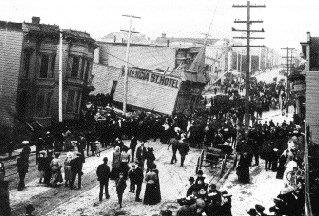 [These pictures are from the 1906 Quake, the greatest of San Francisco�s big earthquakes (1865, 1868, 1906, 1957, and 1989). As an interesting historical note, Dr. Paul Castelhun, the Cal graduate who had stolen the Stanford Axe in 1899, was present to pull survivors from the wreckage of the Valencia Hotel (shown at right) and to provide medical aid.]
Sources of Information:
Beat the Quake, Steps to Take, Marin County Office of Emergency Services
Quake Country: http://www.sfgate.com/chronicle/special/quakes/
On Shaky Ground: http://glinda.cnrs.humboldt.edu/earthquakes/shaky_ground.html
FREEBORN HALL
Unit 1, 2650 Durant Avenue
University of California at Berkeley
|
| |