Scott's Health Tips:
Fingerprinting
Health Tip #10, 31 October 1996
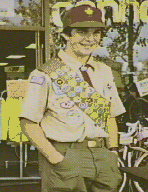 Four years ago today, on Halloween 1992, I completed my Eagle Scout project in which I organized a free program to fingerprint young children at Northgate One Mall, San Rafael. The parents kept the identification card and put it away in their files, just in case something "bad" were to happen to the child. The card, which contained vital statistics as well as the fingerprints, could be given to the police to help them in their search.
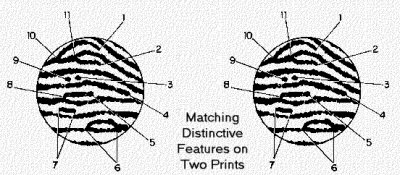
Fingerprints are simply the patterns of friction ridges on the outside layer of the skin. Specifically, the ones on the tips of the fingers are the ones primarily used for identification purposes because their marks are always left behind when we grasp objects. Genetically, there is a one in 2.98 x 1042 chance that two people will have the same fingerprint pattern! Scars, mutilations, and amputations won�t make identification harder, but easier because they add to the variation of that finger.
The sweat pores located within these skin ridges release moisture which makes patterns on everything we touch. Sometimes they are visible, such as on glass or clear surfaces, and sometimes they are invisible. In that case, the investigator can use powders, chemicals, lighting, lasers, x-rays, and computers to develop the print so that it can be collected from the surface through lifting, photography, or casting. The image can then be run through a computer which will match the patterns to databases of fingerprints belonging to known individuals. For example, those of you who received your driver�s license probably remember the DMV scanning your thumbprint into their computers.
You might want to consider making a set of fingerprints for yourself. Usually you can obtain the identification card at any police station and then use a pad of ink to roll the fingerprint into the correct squares for each finger. Include other information such as full name, date and place of birth, ethnicity, hair and eye color, distinguishing features, photograph, emergency contact information, etc. The police do not need a copy of this; just put it a safe place in your files or back home. The UCPD (642-6760) will do all this for $12.50
 If somebody, such as a little sibling or a roommate, does disappear, first be sure that the person is indeed gone and then call the police immediately. Contact "Operation Lookout" (1-800-782-7335) who will help advertising and creating MISSING posters. Distribute flyers, interview acquaintances, check the hospitals and morgues, contact newspapers, etc.
Sources of Information:
Fingerprint Consulting: http://www.digitalcave.com/consult/
Operation Lookout: http://www.premier1.net/~lookout/
FREEBORN HALL
Unit 1, 2650 Durant Avenue
University of California at Berkeley
|
| |