Scott's Health Tips:
Family History
Health Tip #6, 3 October 1996
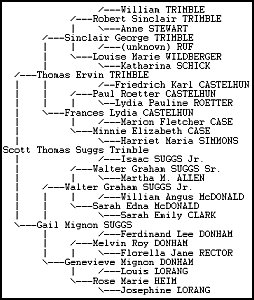 As some of you might already know, one of my hobbies is genealogy. For 4� years I�ve been researching my ancestors, learning more and more about where I come from. It is actually a lot of fun! It�s kinda like a jigsaw puzzle since I am piecing together clues from various historical sources in order to identify great-great-grandfather. It is not just a hobby for the retired anymore, and, in fact, it�s better to begin at our age because many elderly relatives are still living and willing share valuable family legends.
Genealogy is also important because of its Health aspect, hence this week�s Health Tips. We all inherit traits from our mother and father who inherited their "genes" from their parents, and so forth. This, of course, is why you might have brown hair like your father or artistic talent like your grandfather. Besides such obvious physical characteristics, we can also inherit certain diseases or the potential to develop a disease. There are thousands of genetic disorders that can be inherited, so by knowing about the sicknesses or causes of death of your ancestors, you can also learn to what diseases you might be susceptible.
A common genetic disease, which affects 1 out of 2500 whites, is cystic fibrosis (buildup of mucus in the lungs and organs, increases vulnerability to pneumonia). Tay-Sachs (seizure, blindness, weakening of motor skills) is most common in descendents of central European Jews. Sickle-cell anemia (reduces oxygen-carrying capability of red blood cells) affects 1 out of 400 blacks. Huntington�s disease (degeneration of the nervous system) is a deadly disease that doesn�t manifest until middle age. Phenylketonuria (affects breaking down an amino acid) affects 1 in 10,000 people. Cancer, diabetes, and allergies are also usually inherited.
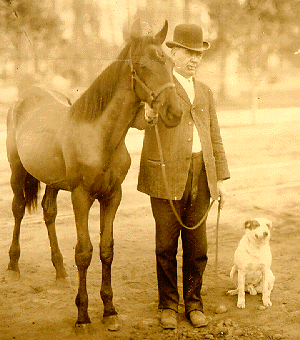 People who are related are more likely to be carriers for the same disease, thus children from such a marriage are more likely to gain the right gene combination to actually develop the disease. Cousin-marriages are taboo in most modern American cultures, but it was very common among our ancestors. It may sound gross now, but even we are not exempt from have such matches in our family tree. One ancestor, F.L. Donham, from Indiana was the child of parents who were both half 1st cousins and second cousins. Everybody has ancestors who married. How else does one explain the fact that we have more ancestors each generations back, but the world population was increasingly smaller? We have duplicate ancestors. [Former Wild West gambler M.F. Case (left) poses in this early 1900s photo with one of his famous race-horses.]
If you know that your family has a history of a certain disease, doctors can do tests to see if you are a carrier. They can even use techniques such as amniocentesis, chorionic villus sampling, fetoscopy, and ultrasound to see if an unborn child will develop the disease. If the results are positive, it is sometimes possible to begin early treatment that might reduce the effects. DNA researchers are also working on developing ways of actually changing the genes in the embryo, thus altering the person so he or she will not become sick.
Sources of Information:
Biology: 4th Edition, by Neil A. Campbell, 1996.
Donham Family History, by Scott T.S. Trimble, 1995.
FREEBORN HALL
Unit 1, 2650 Durant Avenue
University of California at Berkeley
|
| |