Scott's Health Tips:
Breast Cancer: Breast Self-Examination
Health Tip #25, 19 March 1997
 The following information is taken directly out of the health manual Take Care of Yourself, by Donald M. Vickery and James F. Fries, Addison-Wesley Publishing Company, 1996. Please help yourself to your own copy of this Health Tip; extras are located in the HW display case across from the kitchenette on the side-wall of the Security Monitor booth....
Most lumps in the breast are not cancerous. Most women will have a lump in a breast at some time during their life. Many women�s breasts are naturally lumpy (so-called benign fibrocystic disease). Obviously, every lump or possible lump cannot and should not be subjected to surgery.
Cancer of the breast does occur, however, and is best treated early. Regular self-examination of your breasts gives you the best chance of avoiding serious consequences. Self-examination should be done monthly, just after the menstrual period. The technique is as follows:
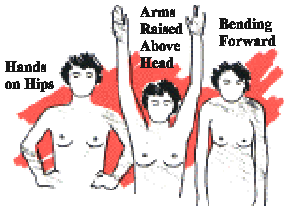
1. Examine your breasts in the mirror, first with your arms at your sides and then with both arms over your head [and then while bending slightly forward at the waist]. The breasts should look the same. Watch for any change in shape or size, or for dimpling of the skin. Occasionally a lump that is difficult to feel will be quite obvious just by looking.
2. Next, while lying flat, examine the left breast using the inner finger tips of the right hand and pressing the breast tissue against the chest wall. Don�t pinch the tissue between the fingers; all breast tissue feels a bit lumpy when you do this. The left hand should be behind your head while you examine the inner half of the left breast and down at your side when you examine the outer half. Don�t neglect the part of the breast underneath the nipples or that which extends outward from the breast toward the underarm. A small pillow under the left shoulder may help.
3. Repeat this process on the opposite side.
Any lump detected should be brought to the attention of your doctor. Regular self-examination will tell you how long it has been present and whether it has changed in size. This information is very helpful in deciding what to do about the lump; even the doctor often has difficulty with this decision. Self-examination is an absolute necessity for a woman with naturally lumpy breasts. She is the only one who can really know whether a lump is new, old, or has changed size. For all women, regular self-examination offers the best hope that surgery will be performed when, and only when, it is necessary. Many doctors recommend repeating a self-examination in the shower, where smooth, slightly soapy skin can make lumps easier to detect.
Sources:
Take Care of Yourself, Vickery & Fries.
Y-ME National Breast Cancer Organization
FREEBORN HALL
Unit 1, 2650 Durant Avenue
University of California at Berkeley
|
| |